This website uses various technologies including cookies for personalization, website usage and performance measurement, and targeted advertising. Information about your site visit may be stored by or shared with third parties as described in our Privacy Policy. By continuing to browse, you agree with our collection and disclosure of your information.
Cookie Settings
This website uses various technologies including cookies for personalization, website usage and performance measurement, and targeted advertising. Information about your site visit may be stored by or shared with third parties as described in our Privacy Policy. By continuing to browse, you agree with our collection and disclosure of your information.
Strictly Necessary
This website uses various technologies including cookies for personalization, website usage and performance measurement, and targeted advertising. Information about your site visit may be stored by or shared with third parties as described in our Privacy Policy. By continuing to browse, you agree with our collection and disclosure of your information.
This website uses various technologies including cookies for personalization, website usage and performance measurement, and targeted advertising. Information about your site visit may be stored by or shared with third parties as described in our Privacy Policy. By continuing to browse, you agree with our collection and disclosure of your information.
NO MINIMUM ORDER - SAME DAY SHIPPING
One or more installed browser plugins are blocking URL parameters. To properly calculate savings, or to checkout, you must disable it before you continue. Please click HERE after you disabled it to retest, or HERE for an instructional video
Not all brake shoes are built the same. Variations in design, strength, and friction material make each type suited for a specific kind of truck or operating environment. Whether a vehicle runs steady highway routes or spends its life in stop-and-go vocational work, understanding the types of brake shoes used in heavy-duty applications helps ensure consistent braking and longer service life.
This guide explains the common types of brake shoes found on modern semi-trucks and commercial vehicles, how they differ in construction, and what each design offers for performance and durability.
Every drum brake system uses a pair of shoes that press outward against the inside of the brake drum to create friction. But not all of them have the same mechanical design. The configuration of the brake shoes determines how they engage the drum and how braking force is distributed.
Leading and Trailing Shoe (Standard S-Cam)
Leading and trailing shoes are the most common design on modern heavy-duty trucks. The leading shoe applies first when the brakes engage, generating most of the stopping power, while the trailing shoe stabilizes and completes the braking cycle. This setup provides balanced, predictable performance and is used widely on steer and drive axles.
Twin-Leading Shoe
In a twin-leading design, both shoes act as leading shoes during forward motion. It produces higher braking torque in the forward direction but slightly less in reverse. Twin-leading systems are often found on older or specialty applications that need stronger forward braking response.
Duo-Servo Shoe
In a duo-servo configuration, both shoes are self-energizing, meaning the motion of one shoe helps push the other into the drum. This configuration creates strong braking force in both directions but generates more heat and wear under heavy loads. It's less common today but still found in certain vocational and trailer brake designs.
S-Cam Operation
Most heavy-duty drum brakes use an S-cam mechanism that spreads the shoes apart when air pressure applies the brakes. The S-cam converts rotary motion from the slack adjuster into linear force on the shoes, pressing them evenly against the drum surface.
Brake Shoe Construction and Strength
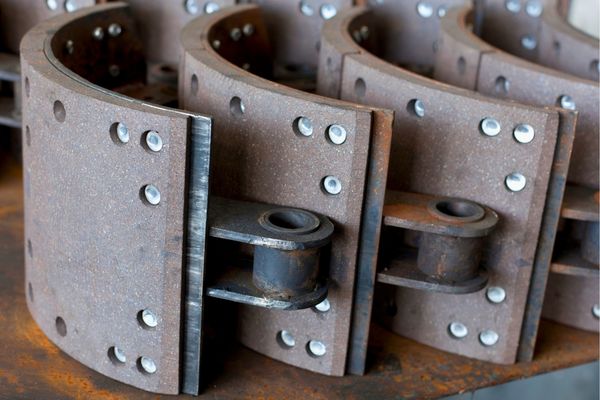
Brake shoes are designed to handle enormous heat and mechanical stress. The way a shoe is built, including its core and mounting components, determines how much load it can safely control and how well it resists flexing under braking force.
Single-Web Shoes
Single-web brake shoes use one central rib to connect the shoe table to the anchor and cam ends. This lighter, simpler design is used widely in line-haul and regional applications where braking demands and axle ratings are moderate. It offers excellent heat dissipation and reduced unsprung weight but isn't as rigid under high torque loads.
Double-Web Shoes
Double-web shoes add an extra reinforcing rib for greater stiffness and strength. They're common on high-GAWR or severe-duty axles, where added rigidity helps prevent shoe flex and uneven lining wear under repeated heavy braking. The trade-off is additional weight and slightly higher cost.
Brake Shoe Lining Attachment Methods
The friction material on a brake shoe must stay firmly bonded to the shoe table under extreme heat and pressure. Heavy-duty brake shoes use two primary attachment methods: riveted and bonded. Both types meet the same performance standards when properly maintained, so the choice often comes down to inspection preference and operating conditions.
Riveted Shoes
Riveted brake shoes use a series of metal rivets to fasten the friction lining to the shoe table. This has long been an industry standard and remains common across most fleet applications. Riveted linings are easier to visually inspect for wear. Once the heads of the rivets are exposed or become flush with the friction surface, the shoe is at the end of its service life.
Advantages: Easier wear detection, proven durability, suitable for most axle ratings.
Considerations: Slightly less contact area between shoe and lining; rivet holes can trap moisture or debris over time.
Bonded Shoes
Bonded shoes use high-temperature adhesives to attach the friction material directly to the shoe table. This creates a full-contact surface and eliminates rivet holes, which can reduce noise and wear irregularities. Bonded linings are common in medium-duty, line-haul, and quieter braking applications.
Advantages: Full friction contact, quieter operation, no rivet wear.
Considerations: Harder to visually gauge wear, more prone to lining lift if exposed to prolonged moisture or corrosion.
Friction Material Types for Brake Shoes
Brake shoes are built with different friction materials to handle varying heat levels, loads, and braking demands. In commercial and heavy-duty vehicles, the main material families are semi-metallic, high-metallic, and low-metallic (non-asbestos) compounds. Each has its strengths and limitations depending on duty cycle and operating temperature.
Semi-Metallic
Semi-metallic linings are the most common choice for heavy-duty air-brake shoes. They contain a mix of metallic fibers, resins, and fillers designed to balance strength, temperature stability, and wear life. This blend gives consistent braking performance across a wide range of operating conditions, making it well suited for regional and on-highway fleets.
Pros: Excellent heat transfer, stable friction under load, long wear life.
Cons: Can produce more noise and drum wear than softer materials.
High-Metallic / Severe-Duty
High-metallic linings contain a higher percentage of metallic content for added strength and fade resistance. They're built for applications that generate extreme heat, such as construction, refuse, and mountainous routes, where braking force and temperature demands are highest.
Pros: Better fade resistance and stopping power at high temperatures.
Cons: Increased drum wear and a harsher braking feel.
Low-Metallic / Non-Asbestos (NAO)
Low-metallic or non-asbestos linings use synthetic fibers, resins, and mineral fillers with little or no metallic content. These are less common in modern Class 8 air-brake systems, but they can still be found in some medium-duty or regional applications where braking temperatures remain moderate.
Cons: Limited fade resistance in severe service; shorter life under high-GAWR or high-heat conditions.
Using a friction compound outside its intended design creates predictable trade-offs. Softer materials in high-heat or heavy-load service tend to glaze and wear quickly, while hard, high-metallic linings on light-duty routes can accelerate drum wear and feel harsh.
Brake Shoes Friction Ratings
Brake linings are rated under SAE J866 friction codes, which describe how the material performs at both cold and hot operating temperatures. If brake shoe temperatures regularly exceed the friction material's rated range, the lining begins to break down, reducing stopping power and increasing fade.
The friction code consists of two letters, such as "FE or GG, that identify the lining's friction range. Each letter represents the average coefficient of friction measured at specific test temperatures.
For example, in commercial vehicles, you may see letter ratings like below:
E = Moderate friction; smoother and quieter, common in lighter or line-haul service.
F = Standard heavy-duty friction; balanced torque output and heat resistance for most regional and on-highway applications.
G = High friction; designed for severe-duty, high-temperature, or downhill-grade service where maximum fade resistance is needed.
The first letter represents expected friction performance at lower temperatures (around 200°F to 400°F), and the second letter reflects how the material performs at higher temperatures (400°F to 650°F). Choosing a friction material rated for the vehicle's duty cycle and application helps maintain consistent braking performance, prevent fade-related failures, and extend lining life.
GAWR and Load Compatibility
A brake shoe's capability should match the gross axle weight rating (GAWR) of the vehicle. GAWR defines how much load each axle can support, and, by extension, how much braking torque and heat its service brakes must manage. Selecting shoes that correspond to that rating is essential for braking efficiency and avoiding premature brake wear.
Common Heavy-Duty Axle Ratings
20,000 lb. GAWR (Light/Medium Duty): Used on regional and lighter line-haul tractors. Typically paired with single-web shoes and semi-metallic linings that emphasize smooth engagement and reduced drum wear.
23,000 lb. GAWR (Standard Heavy Duty): The most common rating for over-the-road and regional fleets. Generally equipped with reinforced shoes and semi-metallic or blended friction for balanced torque and heat control.
25,000 lb. GAWR and above (Severe Duty): Found on construction, logging, and refuse applications. These axles require rigid double-web shoes and high-metallic linings engineered for high-temperature stability and fade resistance.
Heat and Load Effects
As axle weight increases, so does braking pressure and temperature. Heavy axles demand stiffer shoes and heat-tolerant friction materials to prevent flexing, cracking, or premature wear. Underspecifying the shoe for the load leads to distortion and shortened lining life.
Over-Spec Considerations
At the other end of the spectrum, installing severe-duty shoes on a lighter axle introduces its own problems: harsher braking response, more noise, and accelerated drum wear. The shoe may survive longer, but at the cost of comfort and component life elsewhere.
Application Tip
When a vehicle operates under mixed loads or alternating routes, spec the brake shoes for the heaviest sustained duty the truck regularly encounters. That keeps braking performance consistent and prevents premature wear during peak load periods.
FMSI Numbers and Fitment Identification
Every brake shoe design is identified by an FMSI number, a universal part-numbering system created by the Friction Materials Standards Institute. This code standardizes brake shoe identification across the industry, ensuring that the correct part can be matched to a vehicle regardless of the shoe's manufacturer or brand.
The FMSI number corresponds to a specific brake shoe shape and application, making it easy to confirm fitment for the intended axle, brake assembly, and drum size. This system simplifies part lookup for manufacturers, distributors, and installers, serving as a common reference throughout the aftermarket.
Easy identification: The number is typically stamped or printed on the shoe and packaging label.
Simple format: Common examples include 4515Q, 4707Q, and 4709Q, each corresponding to specific S-cam brake configurations and sizes.
Consistent fitment: Verifying the FMSI number before ordering ensures proper fitment for the brake system and vehicle application.
Matching Brake Shoe Type to the Job
Choosing the right brake shoe is about matching the shoe's design, friction, and construction to the vehicle's workload. Understanding how factors like GAWR, duty cycle, and material quality work together helps ensure reliable performance and longer component life. For fleets planning their next brake service, explore our full selection of heavy-duty brake shoes and replacement parts from brands like Match Made, Bendix, Meritor, Haldex, and more. Need help with cross references? Contact our parts team to confirm the correct fit for your application.