This website uses various technologies including cookies for personalization, website usage and performance measurement, and targeted advertising. Information about your site visit may be stored by or shared with third parties as described in our Privacy Policy. By continuing to browse, you agree with our collection and disclosure of your information.
Cookie Settings
This website uses various technologies including cookies for personalization, website usage and performance measurement, and targeted advertising. Information about your site visit may be stored by or shared with third parties as described in our Privacy Policy. By continuing to browse, you agree with our collection and disclosure of your information.
Strictly Necessary
This website uses various technologies including cookies for personalization, website usage and performance measurement, and targeted advertising. Information about your site visit may be stored by or shared with third parties as described in our Privacy Policy. By continuing to browse, you agree with our collection and disclosure of your information.
This website uses various technologies including cookies for personalization, website usage and performance measurement, and targeted advertising. Information about your site visit may be stored by or shared with third parties as described in our Privacy Policy. By continuing to browse, you agree with our collection and disclosure of your information.
NO MINIMUM ORDER - SAME DAY SHIPPING
One or more installed browser plugins are blocking URL parameters. To properly calculate savings, or to checkout, you must disable it before you continue. Please click HERE after you disabled it to retest, or HERE for an instructional video
Each year, roadside inspectors check millions of commercial vehicles for safety violations, and every year, thousands don't pass. Brake-related issues make up the largest percentage of out-of-service violations, making bad brakes one of the easiest ways for trucks to be taken off the road.
To spotlight this critical safety issue, the Commercial Vehicle Safety Alliance (CVSA), in conjunction with the FMCSA, Transport Canada, and local law enforcement agencies, conducts two enforcement events each year dedicated to brakes: Brake Safety Week and Brake Safety Day.
Digging into the results from past CVSA brake inspections reveals a lot about these events, such as how many vehicles are pulled for inspection, how many fail, which brake components are in the spotlight, and how participation has shifted across the U.S., Canada, and Mexico. With Brake Safety Week 2025 on the horizon, now's a good time to review the trends.
CVSA Brake Safety Week 2025 is scheduled for August 24 to 30, with multiple jurisdictions in the U.S., Canada, and Mexico likely to participate. Brake Safety Week is held annually and typically occurs the last full week of August (starting Sunday and ending on the last Saturday of August).
Before 2020, Brake Safety Week was held in mid-September, so keep in mind that future dates are subject to change. The good news is that CVSA announces the dates of inspection week usually three months in advance, giving you plenty of time to prepare.
When Is CVSA's National Brake Safety Day?
CVSA also holds a surprise one-day brake inspection event each year called Brake Safety Day. Unlike Brake Safety Week, CVSA does not publicly announce the date it will occur and maintains that it can be held at any time. However, based on CVSA's recent history, we can tell you that National Brake Safety Day usually takes place in late April (as in years 2022-2025) or early-to-mid May (most years 2016-2021). In all but one of these years, it also happened on a Tuesday or Wednesday.
Past CVSA Brake Safety Inspection Dates
Year
Brake Safety Week
Brake Safety Day
2025
August 24-30
April 22
2024
August 25-31
April 30
2023
August 20-26
April 19
2022
August 21-27
April 27
2021
August 22-28
May 16
2020
August 23-29
N/A
2019
September 15-21
May 15
2018
September 16-22
April 23
2017
September 7*
May 3
2016
September 11-17
May 4
* In 2017, Brake Safety Week was a one-day event.
How Many Vehicles Are Inspected During Brake Safety Week?
For Brake Safety Week, CVSA partners with various organizations and jurisdictions in the U.S., Canada, and Mexico, and the total amount of commercial vehicles inspected can vary in any given year based on participation. Generally, you can expect the CVSA to carry out more than 15,000 commercial vehicles during Brake Safety Week and more than 4,000 on the unannounced Brake Safety Day. CVSA will release official totals about 2 to 3 months after each event.
Historically, about 80% to 90% of these brake safety inspections occur in U.S. jurisdictions. Canada typically inspects just under 2,000 vehicles during Brake Safety Week and around 800 to 1,000 vehicles on Brake Safety Day. Mexico has had the most inconsistent participation in Brake Safety Week, ranging from a low of just 9 vehicles in 2023 to a peak of 5,958 vehicles in 2020.
Brake Safety Week - Number of Vehicles Inspected
Year
Total
U.S. Only
Canada Only
Mexico Only
2025
2024
16,725
14,692
1,926
107
2023
18,875
18,031
1,327
9
2022
38,117
34,402
1,975
1,740
2021
35,764
28,694
1,903
5,167
2020
43,565
35,778
1,829
5,958
2019
34,320
31,864
2,456
0
2018
35,080
N/A
N/A
N/A
Brake Safety Day - Number of Vehicles Inspected
Year
Total
U.S. Only
Canada Only
Mexico Only
2025
4,569
3,819
744
6
2024
4,898
3,859
1,021
18
2023
6,829
5,901
894
34
2022
9,132
8,750
382
0
2021
10,091
8,658
946
487
2020
N/A
N/A
N/A
N/A
2019
10,358
8,738
1,620
0
2018
11,531
10,074
1,457
0
Why Are Inspections Totals So Much Lower Now Than in the Past?
According to CVSA's reports, the total number of inspections for both Brake Safety Week and Brake Safety Day has dropped sharply since 2022.* CVSA hasn't offered an official reason, but the shift is clearly reflected in recent data.
In fact, from 2023 to 2025, we've seen nearly 50% fewer inspections than in the past. Brake Week's peak was around 35K to 43K inspections per year from 2019 to 2022. This shift was also sudden, as records show a year-over-year decrease from 38,117 total inspections for Brake Safety Week in 2022 to just 18,875 inspections in 2023.
The declining numbers are mainly attributed to the U.S. and Mexico, as Canada's totals are pretty consistent year after year. Mexico's total inspections have dropped by more than 93% since its peak (2021-2022), suggesting it barely participates in the event nowadays.
But the U.S. trend is more surprising, given that it historically accounted for the most inspections. Aside from U.S. jurisdictions now appearing to conduct near half as many inspections as in its peak years, CVSA's data also suggests U.S. inspections have been in an ongoing decline since 2022.
*Please note that this analysis regarding the decrease in inspections is based solely on data reported to and publicly released by CVSA. This data may not reflect the inspection activities of jurisdictions that are not directly participating in the brake safety campaigns. Therefore, it may not provide a complete picture of the situation, nor does it suggest vehicles are less likely to be inspected than in the past.
How Many Commercial Vehicles Fail Brake Safety Week Inspections?
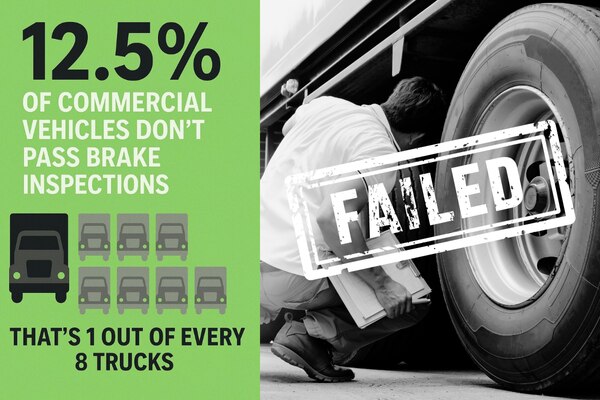
Brake Safety Week usually results in about 12.5% (recent average) to 13% (historical average) of commercial vehicles being handed a brake-related out-of-service violation. That percentage may sound low, but consider that it means about 1 out of every 8 commercial vehicles fail the inspection due to brake problems. Brake Safety Day typically sees slightly lower results (11.7% to 12.5%), which is surprising considering that it occurs without notice on an unannounced date. Meanwhile, the dates of Brake Safety Week are known months in advance.
What Do Inspectors Actually Check During Brake Safety Week?
During Brake Safety Week, CVSA-certified commercial vehicle inspectors will follow operations and procedures outlined in the North American Standard Inspection Program, specifically regarding the Out-of-Service Criteria (OOSC) for brake systems.
Inspectors will check for critical violations on all equipped brakes for the vehicle or vehicle combination. One of the most common violations is out-of-adjustment brakes, but every aspect of the brake system has potential for violations. So you'll need to make sure everything is in order, including brake linings, brake lights, and brake lines and hoses. If a brake component is inoperative, missing, or has significant structural damage, it is almost guaranteed to be an OOS violation.
Are Only Brakes Inspected?
In addition to brake inspections, receiving a non-brake-related out-of-service violation can also be common during Brake Safety Week. During the week, brake checks are usually considered a Level IV "special" inspection dedicated to brake components. However, select jurisdictions may also be conducting Level I (vehicle + driver), Level II (walk-around vehicle + driver), or Level V (vehicle only) inspections for vehicles that were not recently inspected. Additionally, any obvious out-of-service violations that can be easily seen with the naked eye are sure to be cited by the inspector.
CVSA Brake Safety Week Focus Areas
During each brake safety event, CVSA chooses a component of the brake system as a special focus area to conduct additional statistical research. Focus areas don't supersede the full brake inspection, but these added points of emphasis can potentially mean inspectors spend a little bit more time examining these components. Once CVSA has chosen a brake focus area, they usually stick with the same focus area for multiple years before changing. Historically, the focus area for Brake Safety Day will match the focus area for Brake Safety Week.
CVSA Brake Safety Focus Areas Year by Year
Year
Focus Area
2025
Drums and Rotors
2024
Drums and Rotors
2023
Drums and Rotors
2022
Brake Hoses & Tubing
2021
Brake Hoses & Tubing
2020
Brake Hoses & Tubing
2019
Brake Hoses & Tubing
2018
ABS
2017
ABS
2016
ABS
PBBT Inspections
Select jurisdictions may also conduct performance-based brake tester (PBBT) inspections. About 1 out of every 17 commercial vehicles (6%) typically fail this inspection and receive an out-of-service violation, according to historical Brake Safety Week/Day data.
A PBBT inspection measures braking efficiency to ensure the vehicle meets regulations for performance and minimum stopping power. Most commercial vehicles must have a minimum braking efficiency of 43.5% or more to pass the test and avoid an out-of-service violation. In the U.S., some commercial vehicle types require a higher efficiency rating. For example, the standard for passenger-carrying vehicles ranges from 52.8% to 65.3%.
CVSA doesn't release data on which jurisdictions perform PBBT inspections, but around 400 vehicles have been inspected during Brake Safety Week each year since 2022. Around 100 commercial vehicles usually undergo PBBT inspections on Brake Safety Day.
Avoiding Brake System OOS Violations
The best way to avoid receiving a brake-related OOS violation, or any safety violation for that matter, is regular maintenance and repair of your commercial vehicle. In addition to routine maintenance, pre-trip inspections are vital to catching brake issues early. Keeping accurate fleet records for mileage can also help you prepare for when brake parts are reaching the end of their service life.
For high-mileage and heavy-duty vehicles, almost all brake parts will eventually wear down and need to be replaced. If you are shopping for new parts, JIT Truck Parts offers brake system components from brands such as Match Made, Haldex, ConMet, MGM, Bendix, Meritor, and others.
Does an active CVSA decal exempt you from Brake Week inspections?
No, since Brake Safety Week inspections are considered Level IV "special" inspections according to the North America Standard Inspection Program, having a CVSA decal will not exempt your vehicle. Level IV inspections target a specific vehicle component, typically as a part of a campaign to gather data for a research or safety study. CVSA decals are primarily used and issued for full vehicle inspections only (Level I and Level V).
What happens when you receive an out-of-service violation?
If a vehicle receives an OOS order because of a critical brake defect or any other violation, it is prohibited from operating or continuing on the roadway until all identified violations from the inspection are resolved or repaired. Violations can also affect your CSA and DOT safety records and are recorded within the SAFER system for public record. Reinstatement after an OOS order can involve paying fines and passing a reinspection to ensure the issues are corrected. Even for minor violations that do not lead to an OOS order, the FMCSA requires carriers to sign and return their inspection reports within 15 days, certifying that all repairs have been completed.
Are Brake Safety Week and Brake Safety Day inspections random?
Generally, yes. Inspectors may stop vehicles at weigh stations, roadside, or at designated mobile sites. Most vehicles are selected at random, but others may be flagged based on visible defects, past violations, or inspection targeting systems.
Is Brake Safety Week always in August?
No. Before 2020, Brake Safety Week typically took place in September. Since then, it's been held in late August, though dates can shift year to year.
Are the same brake components inspected every year?
Yes, but each year, CVSA also selects a specific brake component as a focus area. This component receives added scrutiny for data collection purposes but does not replace a full brake system inspection.